Carbonnade à la flamande
By Jessica – January 28th, 2007
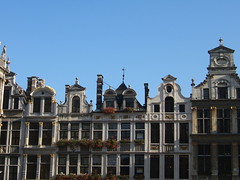 Belgium not only has beautiful scenery, amazing medieval architecture and a fascinating history, it also has some awesome food. Belgian waffles and Belgian chocolates are the obvious examples, along with the inescapable (and irresistible) frites, preferably served with a hefty pot of moules or a juicy steak.
But the country has a host of other delicious dishes to offer as well: creamy soups with fish or chicken (waterzooi); salads and fritters made with North Sea shrimp; endives/chicory baked under a bubbling blanket of ham and cheese; sweet lobster and other seafood; sausages and game; tender white asparagus, waxy yellow potatoes and bright green Brussels sprouts (don’t scoff: Brussels sprouts sauteed in butter with caramelized onions and mustard are delightful).
 My favorite Belgian recipe features one of Belgium’s other great gifts to the culinary world: beer. Carbonnade à la flamande is Flemish beef stew in which beef and onions are simmered in Belgian ale until the meat is tender, the onions are sweet and the ale has cooked down into a rich, dark gravy. I imagine carbonnade was as popular in the 14th century as it is today.
The key - as with so many great dishes - lies in taking a few good ingredients and treating them well to create something much greater than the sum of its parts. And those parts (to feed two people generously) are as follows:
- 500 g cubed stewing/braising beef
- 2 slices bacon, chopped
- 3-4 medium onions, sliced
- 1/2 tablespoon brown sugar
- 1/2 tablespoon flour
- 1 bottle Belgian ale
- 500 mL strong beef broth/stock
- 1-2 bay leaves
- pinch of thyme (fresh or dried)
- pinch of allspice (optional)
- salt and pepper
- chopped parsley
- mustard
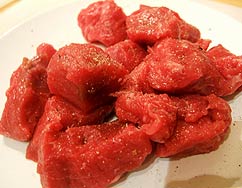 The basic recipe is very straightforward. You can make the carbonnade either entirely on the stovetop, or you can start it on the stove and finish it in the oven. If you’re going to use the oven, preheat it to 175C/350F.
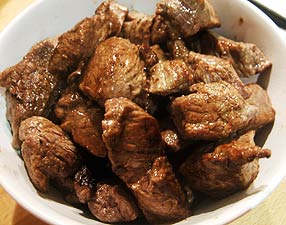
Season the beef generously with salt and pepper and brown it on all sides in a dash of oil over medium heat in a heavy-bottomed pot or casserole. When the meat is browned, take it out of the pot and set it aside, then deglaze the pot by adding a splash of beef broth and scraping up any browned bits with a wooden spoon. Add the broth and bits to the beef, then drop the bacon into the pot and fry it over medium heat until it’s brown. Remove the bacon with a slotted spoon and set it aside with the beef.
Put the onions in the pot and fry them gently in the bacon fat until they start to turn soft and golden, which will take about 15 minutes. After the onions have been cooking for a few minutes, sprinkle over the brown sugar, which will help them caramelize slightly.
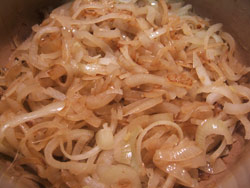
Once the onions are cooked, sprinkle the flour over them and stir it in (a lot of recipes call for tossing the beef cubes in flour before browning them, but I’ve found that you wind up just browning the flour instead of the meat when you do this). Then add the beef, bacon and any accumulated juices to the onions in the pot.
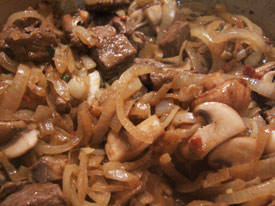
Now comes the fun bit: turn up the heat slightly, and pour in the bottle of ale. It will go all fizzy for a few seconds, but then it will calm down. Add enough beef broth to cover the meat and onions, along with the bay leaf, thyme, allspice if you’re using it, and some salt and pepper.
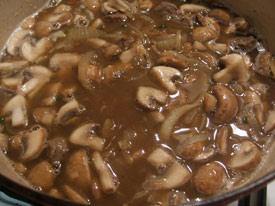 Bring this to a boil, then cover and place in the oven. Let it cook for about 2 hours, stirring occasionally, until the meat is tender (if you’re cooking the carbonnade on the stovetop, simply simmer it over low heat for 2 hours; you’ll have to stir it slightly more often to prevent it from burning to the bottom of the pot).
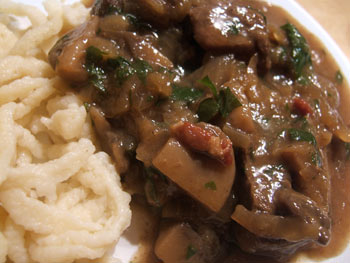
To finish the carbonnade, stir in a handful of chopped parsley and a tablespoon or two of mustard if you’d like. Carbonnade is traditionally served with boiled potatoes or sometimes buttered noodles, but I think Spätzle is really the perfect accompaniment (so carbonnade is from Belgium and Spätzle is from southern Germany—it’s still a match made in heaven). A salad of chicory or endive dressed with a mustard vinaigrette makes for a sprightly accompaniment to balance out the dark, rich carbonnade.
There are just a few things to take note of if you’re making carbonnade. First of all, the beer: If you can get hold of Belgian ale, I highly recommend using it, even if it is more expensive than your average bottle of beer. I used a Chimay Blue the first time I made carbonnade, and it worked so well that I’ve stuck to it ever since. Chimay Blue is a fairly dark ale which gives the carbonnade a pleasing depth. I’ve tried a Leffe Radieuse as well, which is dark and malty, but I thought it gave the carbonnade a slightly bitter edge. If you can’t get hold of Belgian ale, try some other well-rounded copper ale. I would avoid using a stout, however; beef and Guinness stew is great, but that’s not what this recipe is meant to be.
Also, resist the temptation to add too much butter or oil to the pot while you’re browning the meat and sautéing the onions; otherwise the final product could taste greasy.
The allspice, mustard and herbs are really “optional extras”. For true medieval flair, carbonnade should have a spiced, sweet-and-sour tang to it. To achieve this, some cooks spread mustard on a piece of gingerbread and place the bread on top of the carbonnade; as the carbonnade cooks, the mustard-smeared bread breaks down, thickening and flavoring the stew.
Since I don’t typically have gingerbread lying around my house, I make do with the allspice and a hefty dollop of wholegrain mustard (cloves might be interesting to experiment with as well). It’s also not uncommon for vinegar to be added once the carbonnade is done, but I find that the mustard alone gives the stew enough sharpness. The sugar provides the sweetness, though I’ve also seen recipes that call for a spoonful of red currant jelly for the same effect. And as for the thyme and the parsley: if you don’t have any, don’t fret.
And finally, you may have noticed that the pictures accompanying this recipe clearly show mushrooms in my carbonnade. It’s true, I have on occasion used mushrooms if I happened to have them in the fridge. It works out fine, but if you tip the delicate mushroom/meat balance, you just wind up with beef and mushroom stew. This is okay as far as it goes—but again, it’s not carbonnade à la flamande.
 I’ve since decided that “purity of spirit” is what’s called for in a carbonnade. Beef, beer and onions are really all you need to create a hearty winter meal fit for a medieval monarch—or a 21st-century foodie.
Comments
Wow, I’m impressed, the recipe is a decent one and finally Belgian beer is getting its due :) I’m Belgian, but you probably guessed that! Rave on, Erwin.
Thank you - I’m glad to have the approval of a Belgian (and a fellow translator, no less!) :-)
I cooked this for myself last night after discovering this recipe some weeks back and wanted to let you know how wonderfully it turned out. Rich, sweet, and dark. I tried taking some photos of the meal but only have my phone to do so and they didn’t do justice to it. Thanks very much and I’ll definitely be adding Carbonnade í la flamande to my repertoire!
Great, I’m happy it turned out so well! Like most stews, it’s a tough meal to take a good picture of, camera phone or no. But in the end, it’s the taste that counts!
Odool beer (non alcoholic) is supposed to be just as good according to america’s test kitchens, what do you think?
I first saw this Carbonnade recipe on America’s Test Kitchen show today. I think they only used the beef, the onions, beer and some tomato paste. How does that sound to you? I tried getting that recipe but couldn’t. Thanks. Sunday, July 29th at 8:11pm. My e mail address is.. Mammer@optonline.net If you can help me, I would appreciate it.
Hi Madeleine, check out this recipe: http://tinyurl.com/6tcnb It’s a carbonnade recipe from Cook’s Illustrated magazine (associated with America’s Test Kitchen) which uses tomato paste, as you mentioned. It also happens to be one of the recipes I based my own recipe on!
That sounds like an excellent recipe, Jessica. I’ve never actually eaten it with bacon; we usually add some carrots in, which gives it a sweet touch.
People who prefer white meat can also use chicken or turkey. It’s also lighter and goes great with frites :-).
I made this recipe for my boyfriend who is from the north of france. He enjoyed it! This recipe was easy and delicious… I served it with some good old fashioned potato pancakes.
Give it a shot
Ooh, potato pancakes - great idea!
This is just what I’ve been wanting to make. The last time I tried it, I didn’t use Belgian ale and I didn’t really think it was worth repeating. I hope I can find the ale you recommend because I can see what a difference it makes. Have you posted anything about how to make great spaetzle? Thanks for confirming my suspicion about dredging beef before browning. Thanks for all the good hints. Do you have a blog?
Hi Linda - I haven’t yet posted anything about Spätzle, but that’s definitely on my list of things to write about here!
I do indeed have a personal blog at http://wordridden.com - but unfortunately, I’m almost as bad about updating Wordridden as I am about updating this site… :-(
Which one of the hundreds of Belgian beers do you recomend? What size bottle? I’m going to make this in a week and a half and would like to know your thoughts. thanks.
I’ve searched for this recipe after hearing about it Garrett Oliver’s ‘The Brewmaster’s Table’. The book is a must if you’re looking to match beer with food and for this Belgium dish he reccomends cooking and matching it with a Belgium dubbel or Flanders brown ale. The Chimmay Red is a dubbel but I’m sure the slightly stronger Blue works wonders as well! I’ll let you know how it turns out when I try it in a few weeks.
I made a fantasic vegan version of this using seitan (wheat-meat) and by omitting the bacon - thanks
Cool, it’s great to know that even such a meat-oriented dish like this can be adapted for a vegetarian or vegan diet!
I’ve made this recipe multiple times over the past couple months and have gotten nothing but rave reviews. I opt for putting mustard smeared gingerbread on top while it cooks instead of the allspice. I do double batches and freeze some in individual containers- when I know its going to be a cold day, I thaw it out and bring it to work for lunch to warm me up. Its definately going to stay in my cooking rotation, especially over the cold months.
I just made this (sans bacon because I didn’t have any) and it was fantastic - my friends thought so too. I served it with sauté potatoes, which seemed to go quite well! Thanks a lot.
Great article- super well written and informative. I have read in Escoffier’s recipe for carbonnade flamande he calls for "using stout or old Lambic". The hardly-hopped sour beers could add depth of flavor without bitterness. Cheers!
OK, that sounds absolutely incredible! I was looking for a pot roast recommendation in the Good Eats group on Live Journal, and someone there pointed me here. I hope to find a decent ale for it tomorrow, we’ll see how it turns out!
BTW, you mention Tucson. Do you ever eat at El Charro when you’re there? It’s one of my favorite restaurants and salsa sources. There’s also an excellent salsa that is sometimes carried at Albertson’s (again, when you’re state-side in Tucson) called Arriba, they have a medium-hot chipotle salsa that is great.
I haven’t been to El Charro yet, but I’ve heard that it’s good. I’ll have to try it out next time I’m in Tucson. Thanks for the tip!
And I’ll definitely look out for that Arriba salsa - I adore chipotle chiles!
I am from Belgium and my mother use to cook it with onion,brown beer ,bundle of fresh thyme ,bay leave and parsley tied together and fews prunes, salt and pepper its was very tasty and everyone love it.
Like a lot of people I’m finding your variations a little late… but TASTY.
I too lacked the gingerbread, but I substitued quatre epice.. the cloves were a little much, I found, but added a nice body that /would/ work if the balance could get dialed in…
finally got the chance to make this dish! it taste amazing, i did it without mushroom, thanks for this yummy recipe!
Thank you for this recipe! It was delicious, and thanks to you! ;)
I made this last night and it turned out great. I dropped in two medium slices of fresh french bread, liberally coated with dijon mustard. Great meal! I also cooked in an extra slice of bacon, and served it in a bowl ith red potatoes and french bread on the side.
BTW - No bottle size was mentioned, but I would assume that the author used a small bottle of Belgian ale. I always buy Chimay Bleu in the large 750 ml (wine bottle) size. That way, there was plenty of beer to use for the recipe and the other half went into my Trappist glass!
I might try it with St Bernardus Abt 12 next time. It’s one of my favorite beers, and I find it to be a bit more flavorful and full-bodied than Chimay (which is also a favorite).
Thanks for your recipe. I believe that you are correct regarding flouring the onions instead of the beef—the end result is much tastier than flouring the beef.
Definitely going to try this recipe. I went to a place called Spinnekopke in Brussels and had probably the best meal I have ever had, Carbonnade au Lambic. So they just made this stew but used a local Belgium lambic beer. The sauce was just absolutely amazing. I have been on a quest to try and reproduce this ever since and I think this recipe is my first step. Look forward to trying it out!
I’ve been making carbonnades for years, but your method is best! I served it the other night with dumplings - took it out of the oven and put it on the burner, dropped in dumplings and simmered covered for 20 min. (just used Bisquick but this would work with spaetzle). Glazed carrots on the side and really got rave reviews. Thanks!
Thank you for this recipe. Your instructions are great. In Calgary we had blizzard conditions all day so this was the perfect choice for supper. Everyone loved it.
Thank you for this recipe. Your instructions are great and I just want to try this with some beer that I purchased from Local store but do you think if I can use the weiss beer type "Hoegaarden" for example instead of Belgian ale that you’ve mentioned above along with your explanation
Hi Henry, in principle I think a wheat beer (particularly a dark one) would work fine in this recipe, but Hoegaarden is so light and citrusy that I’m not sure I would use it for a beef stew - maybe save it for a fish stew or some mussels and try to find a darker beer for the carbonnade instead. Good luck!
Thanks for the info. I just made this today with a recipe from a cookbook. It asked for dark beer, and while I liked the recipe I definitely felt that Guiness Stout made the stew have a bitter aftertaste. Next time I am trying Chimay, now that I know this is Belgian ale stew…should have browsed the internet before starting the cooking…live and learn!
I almost had all of had all the ingredients to make this. I had to use a different beer because I used my last Belgian beer to steam mussels with the night before. I also did not have any fresh herbs. Regardless, it turned out very well. I served it with potato pancakes.
I had some small mushrooms on hand, but decided to omit them. I think the greatest charm of this recipe is the very minimal number of ingredients bringing a very strong, rich flavor. This will be a staple in my house this winter.
The beer I used was Fullsail Wassail. It reminded me more of the stews I had when I was in Prague though rather than the food I ate in Brussels. http://www.fullsailbrewing.com/wassail.cfm
Thank you for the recipe.
Have been making carbonnade for a number of years, always synthesizing a number of recipes. Yours is the best I’ve come across.
Made it tonight with a few mods: used a lot more beer than in ur recipe — most of a 750 ml bottle of Ommegang, an America abbey style ale.
Also I found the stew was a little thin after 1.5 hours so cooked for last 30 minutes with lid off in oven and then finished on the stovetop, stirring in 1cup or so of finely chopped sourdough bread. After 10 minutes or so it all dissolved and really thickened the dish nicely.
Well done!
This was just what I’d been looking for…used Lagunitas Hairy Eyeball Ale (rich, sweet and moderate hops) and added threes slices of hearty bread slathered with whole grain dijon mustard, which thickened everything beautifully when it cooked in. Hard to believe so few ingredients gave such a complex and hearty flavor. Kudos!
I stumbled across this whilst searching for a crossword puzzle! It sounds great and can
t wait to try it,didnt know the Belgians had such a variety of food(shows how ignorant I am). Thankyou! Regards, Terry Webster, Ipswich, England.Jessica - I have made this for my inn guests various times! Great for a cold night here in the mountains of Minas Gerais, Brazil. The last time I used an artisanal beer - Backer Brown - which is flavored with chocolate in combination with a regular local beer and the results were incredible. The slow cooking allowed the chocolate flavors to meld into the others so that it was not too obvious, but it gave a rich, dark, deep something that really put the sauce over the top. Thanks. Um abraí§o forte. Peter
That’s wonderful, Peter, thank you for letting me know! I like the thought of guests at an inn eating big bowls of carbonnade on a chilly night in the mountains. :-)
The last picture looks delicious. The coloring and mixing of all of the ingredients looks so good my mouth is watering. Love it! Thanks for posting
I first used this recipe last Christmas after returning from a long and very enjoyable weekend in Bruges. I used the Belgium mustard that I brought back from my trip with a bottle of Leffe Brune - amazing but simple recipe. At the time I forgot to bookmark this site, but I have just discovered it again today (in time for our next visit to Bruges in 4 weeks!). Many thanks for a fantastic recipe.
I just had a yummy one. Pot roasted a hunk of shoulder. Salted, peppered, browned meat in some peanut oil and reserved it. 4 smallish onions sliced, sweated at low medium heat, cooked down 15 minutes at medium heat, 3 smushed cloves of garlic and 30 sec more of heat, 3 Tbsp Wondra mixed in onions, a little thyme, 1 Tbsp dark brown sugar; 1 Tbsp cider vinegar, bay leaf, deglazing the pan through the next ingredients. America’s Test Kitchen’s best recipes cookbook recommended 3/4 cup chicken broth added while stirring. One bottle of St. Pauli Girl dark.
Added meat, brought to boil, oven 300 degrees for an hour and a half (flopped the meat after 45 minutes). The broader part of the roast was still a little tough; so I put the oven timer on for 30 more minutes of heat and cooled it overnight in the oven.
Next day, I sliced it from the oven and steamed three chunked red potatoes in the microwave. The sauce looked and smelled so good, I heated it to a boil and tossed the potatoes and meat in with it.
http://donkeyandthecarrot.blogspot.com/2010/12/carbonnade-la-flamande.html
Your recipe is on my Donkey! I am taking part in a Greek contest and i use your PERFECT RECIPE! I would like to thank you cause it was DELICIOUS!!! Thank you, Jessica!
Thanks for letting me know, Foivi! You have some lovely looking recipes on your own site which I’ll have to try out… :-)
Thanks for this super easy to follow recipe (for a complete novice like me)! Carbonnade is in the oven as we speak… cross fingers it comes out well. :)
Very nice to see another proper Belgian stew recipe on the net. Being from Belgium, I absolutely love Flemish Carbonnade. My family usually has it with french fries which are also incredibly popular in Belgium. You can check out my own personal recipe here: http://www.infobarrel.com/FlemishCarbonnadeHowToMakeTheTraditionalBelgianBeefAndBeer_Stew You’re pictures look absolutely gorgeous. Makes me fancy cooking up some stew right now. Many thanks for sharing your recipe.
Jessica - Can you be more precise about exactly which cut of stewing / braising beef you recommend ? The trouble is it can be a term used for anything and my experience is that it turns to tough old boots even after cooking for 2 hours in the oven at about 160í‚°c.
Do you think you could use venison instead of beef in this recipe? This recipe sounds amazing but my husband prefers not to eat beef.
Oh yes, I think venison would be wonderful! I’ll have to try that myself…
Well it’s nearly Bruges time again! So to get me in the mood I’m cooking this great recipe again for my Daughter’s birthday this week. Only 8 weeks to my favourite city on the planet, beer heaven.
My grandmother was from northern France, and she always made beef stew with raisins in it. She said traditionally it should be prunes,but my grandfather didn’t like them.Years later I found out her father was from Belgium. It all makes sense now that I found this recipe!
Really great recipe, thanks for sharing! This is also traditionally made in my father’s family and I wound up with something very authentic-tasting using this. Something worth trying out: I always use Rodenbach as the beer, a very distinct tasting Flemish red ale. It’s slightly sour, but with a lot of fruity notes, which gives it an almost wine-like quality. As a drinking beer, it’s a love it or hate it - drink; but it’s fabulous for a Carbonnade as it has all the qualities you want in your stew.
It’s probably difficult to find outside Europe, but if you happen to live near a good specialty beer store, it’s worth having a look. Since the beer is such an integral part of this dish and the variety of Belgian beers is vast, you can come up with a lot of interesting variations here.
Although I’ve also seen a recipe calling for Stella Artois, which is really an affront to all things Belgian.
I am going to give it a try with deer meat, fingers crossed.
Really great recipe, thanks for sharing! This is also traditionally made in my father’s family and I wound up with something very authentic-tasting using this. Something worth trying out: I always use Rodenbach as the beer, a very distinct tasting Flemish red ale. It’s slightly sour, but with a lot of fruity notes, which gives it an almost wine-like quality. As a drinking beer, it’s a love it or hate it - drink; but it’s fabulous for a Carbonnade as it has all the qualities you want in your stew.
It’s probably difficult to find outside Europe, but if you happen to live near a good specialty beer store, it’s worth having a look. Since the beer is such an integral part of this dish and the variety of Belgian beers is vast, you can come up with a lot of interesting variations here.
Although I’ve also seen a recipe calling for Stella Artois, which is really an affront to all things Belgian.
I love this dish, although I omit the bacon (I don’t like that smokey taste in my carbonnade). For the person asking about stewing cuts, my absolute favorite is boneless short ribs for their richness in flavor and tenderness, but a nice well-marbled chuck works well, too. Shank is another good, cheap stewing cut, but I prefer those other two. Just remember to cook this long enough so the stew meat has time to soften. It will seize up and toughen first before getting soft (has to do with the whole collagen-to-gelatin conversion that goes on with long, slow cooking of well-exercised cuts of meat.) Sometimes it’s done in 1 1/2 hours, sometimes in 3 or so. It depends on the cut and the temps. Just be patient. :)
Also, I’ve had good luck with using New Belgium’s Abbey or Trippel (or a mix of the two) beers in this dish. It’s nice, because I can get a six-pack for about $8-$9 here and have plenty of drinking beer left over. :)
I’ve done this (less the bacon and the stock) for 35 years, and it’s always been a hit. I learned the concept when I was stationed with the Belgian Air Force, 9th Wing Missile. Then, in a moment of daring, I tried it with venison. Superb! And a new family tradition was born…..beer deer (as my children called it). Fast forward to this year and Thanksgiving. In the spirit of the original feast, my granddaughter wanted something traditional for dinner, so venison got added to the menu. It paired well with a Pinot Noir.
Oh, I absolutely love the idea of “beer deer” - thank you for the tip!
The best choice of beer is good belgium brown ale. Something quite thick and alcoholic. I’ve used Chimay Blue and Leffe Brune. Chimay seems to work better as it’s a rounder sweeter beer and balances out the resulting sauce well. Don’t use a blond, blanche or a pils, these really don’t work.
If absolutely no belgian beers available, i mix guinness with san miguel, 50/50 or to your own liking, works out pretty good.
I’m in Florian’s camp on the beer. A Flanders Ale (Rodenbach or Duchesse du Bourgogne or Liefmans Goudenband - or other Flanders red or brown ales) are perfect for carbonnade. I also like the Chimay Blue (or other strong Trappist or Abbey ales) mixed with the Flanders ales for added complexity. The beer is so much a part of the traditional dish, that I refuse to use anything other than the styles listed above. Ask for them at a good liquor store - and make sure you save some to drink with the meal instead of wine. Belgian beers are awesome - in a class by themselves!
This is a wonderful recipe. Next time I will add less oil like you suggested. Please post more recipes like this! Also, I will use a leaner cut of meat.
How many servings does this recipe produce?
This will feed two people generously.
Used your recipe a few times now (using Chimay Blue), I remove the bacon from the fat as I feel it works for my taste and eat it as a snack with a glass of Belgian as I am cooking. As a regular visitor to Bruges this recipe is as good as the best on offer there……cheers.
Pete.R - UK.
I like the way you think, Pete!
How many people does this serve?!!
Hi Marie, this will feed two people generously.
I made a similar recipe over the weekend using Chimay Red (dubbel). The recipe I used didn’t call for bacon, allspice, or mustard. I thought it turned out kinda bitter, not like what I remembered from Belgium, but my sister loved it. Now I see in the comments the suggestions for a Flemish red ale and that sounds fantastic. However I don’t know how I will ever be able to pour my Duchesse du Bourgogne into the stew instead of into my glass, as it is my favorite beer :-) Can’t wait to try your version for comparison. Thanks!
Just collected a 2 kilo shin of beef which is a perfect cut for this type of dish.I have prepared the Greek style of beef stew-STIFADO-previously which is a totally different taste but done in the same style-oh so slow cooking on a low heat.The beer I will use is an English Ale,Adnams Broadside which is 6.2 ABV.Dark,ruby beer with plenty of guts to flavour the dish and all the other ingredients which are found above.Sweet potato mash to compliment the bitter/sour meat with carrots and cabbage.Yummy.Feeding 8 hence the large quantity of meat.Going to marinade meat in beer,thyme,onion and bay overnight.
Hello,
I’ve been making this recipe over the last few years and it’s one of our favourite ones. Just wanted to give you a thumbs up!
Thank you, Ted, that’s very kind! And it’s definitely the season for it now - here in England, anyway!
This is my favorite beef stew recipe of all time! I hope it stays on the internet forever.
Thank you so much, Heather, I’m so glad you like the stew - and I’ll do my best to make sure this site doesn’t disappear (even if I don’t get to update it nearly as much as I’d like!). You’ve also reminded me that I haven’t made this in a while myself, and now is perfect time of year for it. :-)
Best recipe for Belgian stew by far as I have said in the past. Keep em coming Jessica. Pete, UK.
Hi This is Heather McKee again. Had to find your recipe because I’m hosting a party this weekend and want a fantastic easy main dish for meat eaters and this is it. Always get requests for this recipe when I serve it. Chimay Blue is a must. Thanks again.
Sorry. Comments are closed.